
Australian Driveshaft Pty Ltd produces robust drive shafts engineered for the demanding world of heavy trucking, from long-haul B-doubles on highways to mining haul packs navigating remote sites in Western Australia’s Pilbara and Queensland’s Bowen Basin. These critical components transfer massive torque from transmission to differentials, accommodating suspension movement while enduring constant vibration and load variations.
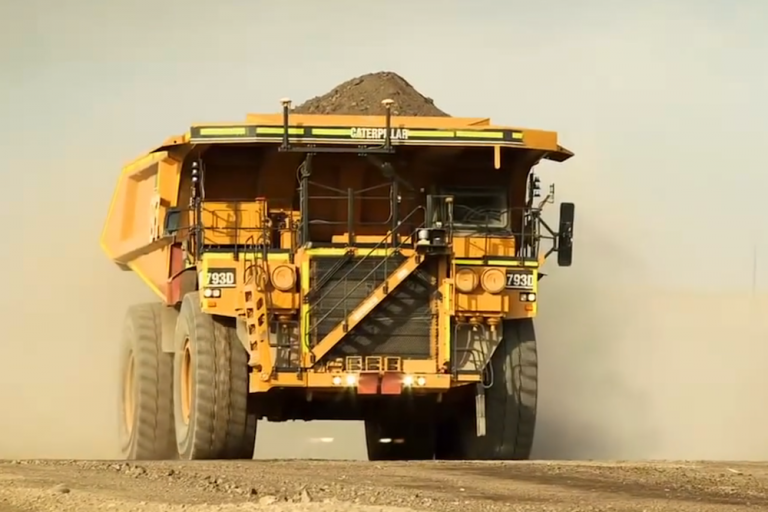
The Pilbara region dominates Australia’s iron ore production, with fleets of ultra-class haul trucks operating around the clock in extreme dust and heat. Drive shafts in these applications often feature multiple sections with carrier bearings, handling torque from powerful diesel engines while the chassis flexes over rough haul roads. In sites near Newman or Tom Price, shafts endure abrasive iron ore dust that infiltrates seals and accelerates wear on universal joints.
From extensive work with mining contractors, our heavy-duty assemblies with quad-lip seals and high-capacity crosses have proven resilient, reducing unplanned downtime significantly. One major operator near Port Hedland replaced standard shafts after repeated center bearing failures from dust ingress; our upgraded designs with enhanced balancing extended intervals dramatically, allowing trucks to maintain high cycle times even in 45°C heat.
Off-road haul packs benefit from shafts with robust torque limiters that protect drivelines when dumping heavy loads, while precise phasing minimizes vibration that fatigues chassis components over millions of kilometers.
While international suppliers like Spicer or Meritor provide solid options (for technical reference only, Australian Driveshaft Pty Ltd is an independent manufacturer), our shafts incorporate features tuned for local dust and temperature extremes, offering better longevity in these punishing cycles.
Core Technical Parameters for Heavy Truck Drive Shafts
| Parameter | Description | Typical Heavy Truck Range |
|---|---|---|
| Torque Capacity Continuous | Ongoing transmission | 5000 to 12000 Nm |
| Peak Torque Handling | Acceleration surges | Up to 18000 Nm |
| Operating Angle Maximum | Suspension articulation | 15 to 25 degrees |
| Carrier Bearing Support | Multi-section shafts | Required for lengths over 2m |
| Tube Diameter | Outer size | 100 to 150 mm |
| Wall Thickness | Strength gauge | 6 to 10 mm |
| Universal Joint Series | Cross type | 1710 to 1810 common |
| Cross Bearing Diameter | Cap size | 48 to 55 mm |
| Spline Count Tractor Side | Transmission yoke | 10 or 16 spline |
| Spline Count Diff Side | Axle input | 39 or 44 spline |
| Balance Specification | High-speed | ISO G2.5 or better |
| Length Configurations | Single or multi-piece | Up to 5 sections |
| Center Bearing Type | Hanger support | Self-aligning rubber |
| Seal Protection Level | Dust ingress | Quad-lip with slingers |
| Material Grade | Tube and components | High-strength alloy steel |
| Phasing Accuracy | Multi-shaft alignment | Within 3 degrees |
| Weight Optimization | Per section | Minimized for fuel efficiency |
| Critical Speed Margin | Resonance avoidance | Above operating RPM |
| Corrosion Resistance | Coating system | E-coat plus powder |
| Temperature Rating | Extreme operations | -30°C to 100°C |
| Impact Tolerance | Road debris | Reinforced guards |
| Service Interval Grease | Maintenance | Every 50,000 km |
| Power Transmission Efficiency | Loss minimization | Over 98% |
| Yoke Forging Method | Strength | Hot forged |
| Quick Service Features | Field replacement | Snap-ring caps |
| Safety Compliance | HVNL alignment | Full Chain of Responsibility |
| Vibration Dampening | Ride quality | Tuned harmonics |
| Length Adjustment | Slip yoke travel | 150 to 300 mm |
| End Yoke Styles | Flange or companion | Various bolt patterns |
| Testing Protocol | Factory validation | Torque cycle and runout |
| Custom Configurations | Fleet specific | Available |
| Critical Speed Calculation | Safety factor | 1.5 minimum |
| Bearing Preload | Carrier stability | Optimized |
| Weld Quality | Tube to yoke | Full penetration |
Eastern Highway Long-Haul B-Double Experiences
Australia’s vast highway network sees B-doubles and road trains logging millions of kilometers annually, with drive shafts managing the complex dynamics of multiple trailers. In routes from Melbourne to Brisbane, shafts accommodate chassis twist on undulating roads while transmitting power through inter-axle sections.
Fleet operators along the Hume Highway value balanced multi-piece shafts that reduce cab vibration on long drives. One interstate carrier upgraded after center bearing seizures from road salt in southern states; our dust-resistant designs with self-aligning bearings restored reliability, cutting roadside repairs noticeably.
Highway speeds demand precise critical speed margins; our engineered tubes avoid resonance that fatigues components over endless kilometers.
Australian Driveshaft Pty Ltd manufactures an extensive lineup of gearboxes designed to integrate perfectly with our drive shafts in heavy truck applications, creating complete power transmission solutions that stand up to Australia’s toughest operating conditions. Transfer case gearboxes for all-wheel-drive mining service trucks feature robust helical gearing in multiple ratios, distributing torque reliably to front and rear axles while sealed housings exclude the fine dust that plagues Pilbara sites. High-capacity models handle over 1000 kW inputs, with integrated cooling fins managing heat during prolonged low-range crawling on steep ramps.
Auxiliary gearboxes for PTO-driven accessories like hydraulic pumps on tippers incorporate quick-engage clutches, precision ground gears ensuring smooth power take-off without driveline shock. Compact planetary designs fit tight chassis spaces yet deliver torque multiplication for winches or cranes common on recovery vehicles operating in remote breakdowns.
Inter-axle differential gearboxes in multi-drive configurations maintain traction across varying surfaces, locking mechanisms providing full torque bias when needed on slippery haul roads after rain. Heavy castings with oversized bearings endure the constant cycling typical of loaded returns in iron ore operations.
Drop gearboxes for low-profile applications lower driveline angles, reducing universal joint stress in low-loader transports carrying oversized mining equipment. Spiral bevel gearing offers quiet efficiency at highway speeds, with multiple mounting options suiting diverse trailer designs.
Safety remains paramount with integrated torque limiters in high-load setups, multi-plate friction designs calibrated to protect downstream components from overload when bogged or hitting obstacles. Overrunning clutches allow safe coasting in long descents, preventing driveline wind-up.
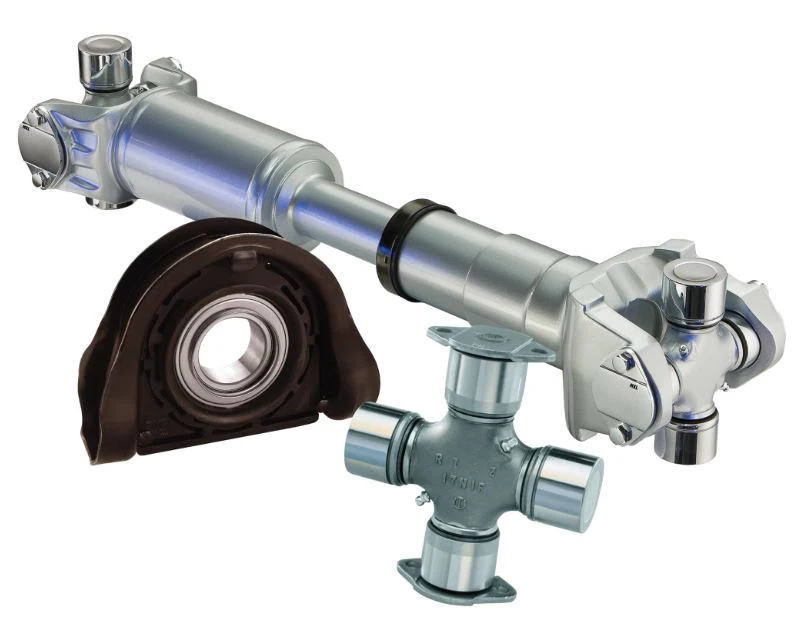
Universal joint kits cover all common series from 1710 to 1880, with premium needle bearings and snap-ring retention for quick roadside repairs. Companion flanges in various bolt patterns connect seamlessly to differentials across major brands, while slip yokes provide necessary travel in articulating chassis.
Hanger bearing assemblies with self-aligning mounts absorb frame twist, rubber isolation reducing transmitted vibration to cabs on rough sections. Custom tube sections enable precise length matching for fleet standardization.
Guarding kits with heavy-duty chains and impact-resistant plastics meet Chain of Responsibility requirements, including quick-release features for efficient servicing. Maintenance packs include specialized greases formulated for high dust and temperature, replacement seal kits, and phasing tools.
Vibration analysis tools help diagnose issues early, while custom balancing services ensure assemblies run true at operational speeds. All gearboxes undergo exhaustive testing—torque cycling, dust chamber exposure, thermal extremes—to replicate real Australian conditions from coastal humidity to outback heat.
These coordinated products deliver measurable benefits in uptime and fuel efficiency. Mining and transport operators consistently achieve higher payload cycles and lower repair costs when specifying complete systems from Australian Driveshaft Pty Ltd, engineered with intimate knowledge of local routes, loads, and environmental challenges. Comprehensive selection charts, installation guides, and torque specifications support optimal matching for specific truck models, axle configurations, and vocational duties nationwide.
Heavy vehicle driveline innovations continue advancing into 2026, with stronger focus on lightweight materials and predictive maintenance aiding efficiency in mining and long-haul sectors across Australia.
Frequently Asked Questions
What causes most drive shaft failures in Australian heavy trucks, especially in mining operations?
Failures often stem from dust ingress wearing seals and bearings prematurely, combined with imbalance from residue buildup or improper phasing in multi-section shafts. In Pilbara mining, abrasive iron ore dust accelerates cross journal wear, while highway trucks suffer from vibration if carrier bearings loosen over time. Regular inspections every 50,000 km, thorough cleaning after dusty runs, and using quad-lip sealed joints prevent most issues, extending life beyond 500,000 km in mixed operations.
How do I correctly measure for a replacement drive shaft on a B-double prime mover?
Park on level ground with suspension at ride height, measure center-to-center from transmission yoke to first carrier bearing, then subsequent sections to differential flange. Account for slip yoke travel—ensure 150-200 mm engagement at full compression and extension without bottoming. Note phasing marks for multi-piece reinstallation to maintain balance and avoid vibration that transmits to the cab on long hauls.
Why are carrier bearings critical in long-wheelbase Australian road trains?
They support intermediate shaft sections, preventing whip and resonance at highway speeds while accommodating chassis flex over uneven bitumen. Poorly maintained bearings cause vibration felt in the sleeper cab, leading to driver fatigue on cross-country runs. Self-aligning rubber-mounted types absorb misalignment better in articulated setups, lasting longer in variable load conditions typical of livestock or general freight.
What torque rating should I specify for a mining site service truck drive shaft?
Aim for 8000-12000 Nm continuous with peaks to 18000 Nm to handle startup loads in soft pit floors or when bogged. Include heavy-duty 1810 series joints and reinforced tubes to resist rock impacts common in haul road maintenance vehicles around sites like Fortescue or BHP operations.
How often should universal joints be greased in dusty Queensland conditions?
Every 20,000-30,000 km or monthly in coal haulage; use high-temperature synthetic grease to displace abrasive dust. Neglect leads to seized crosses and catastrophic failure mid-run, stranding loaded trucks on remote access roads.
Is phasing important when reinstalling a two-piece drive shaft on a highway semi?
Absolutely—align yoke ears within 3 degrees across the carrier to cancel torsional vibrations. Misphasing causes harmonic buildup felt as cab shake at 100 km/h, accelerating fatigue in mounts and bearings over endless interstate kilometers.
What safety features comply with Australian Chain of Responsibility for heavy truck drivelines?
Robust guarding, proper balance to prevent component ejection, and torque limiters where applicable ensure safe operation under HVNL. Documented maintenance records demonstrate due diligence across the supply chain from operator to consignor.
Why do some Australian fleets prefer Australian-made drive shafts over imports?
Local designs incorporate features like enhanced dust sealing and heat-resistant coatings suited to extreme Pilbara conditions, plus faster turnaround for custom lengths matching common Kenworth or Mack configurations running nationwide.
How to diagnose center bearing failure early in a multi-axle truck?
Listen for rhythmic humming increasing with speed, feel vibration through the floor, or note grease purge from seals. Early replacement avoids tube damage and prevents shaft whip that could shear mounts on corrugated outback roads.
What maintenance extends drive shaft life in coastal salt-laden environments?
Regular high-pressure washing to remove corrosive buildup, followed by greasing and inspection of coatings. E-coated assemblies resist rust better on eastern seaboard routes exposed to sea spray during port transfers.